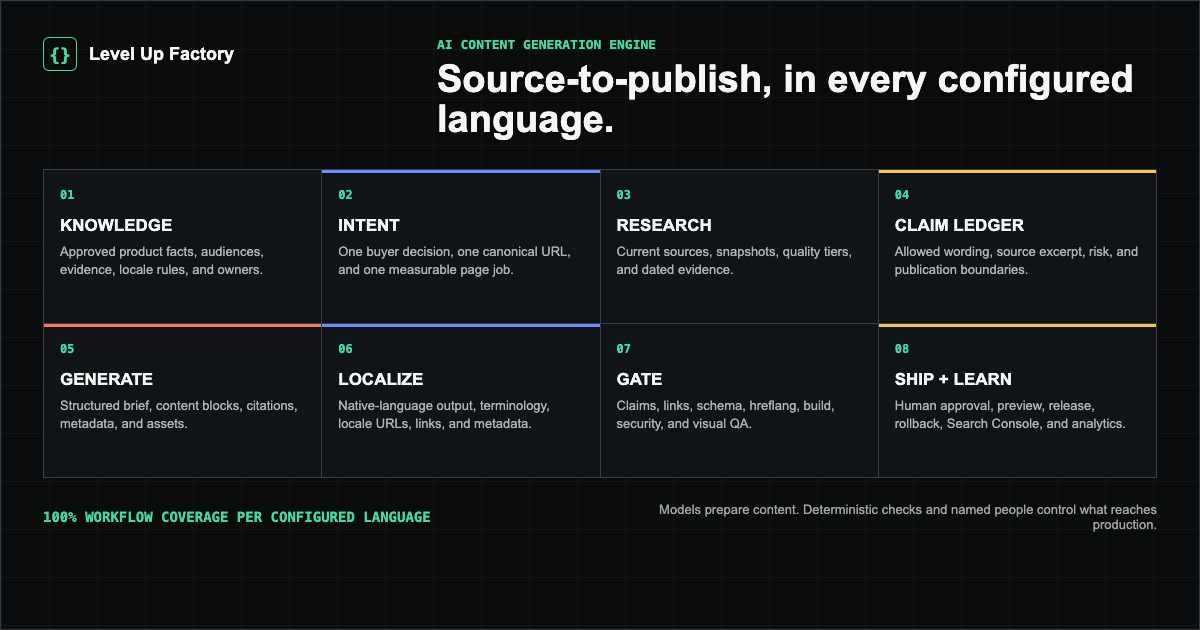
Level Up Factory's AI content generation engine is a governed source-to-publish workflow. It turns approved knowledge and evidence into structured website content through research, claim control, drafting, localization, deterministic QA, human approval, release, and measurement. Its multilingual architecture provides 100% workflow coverage for every configured language, while native-language quality review remains human-owned.
Most AI content workflows are described as if the model receives a keyword and returns an article. That is not the system we install.
A production content engine has to know what the company can say, which source is current, who the page serves, which URL owns the intent, what evidence supports each material claim, which language rules apply, who approves the result, and what happens after publication. Generation is one stage inside that operating loop.
The engine is part of our client-owned AI SEO/SAO Agent Installation. Its operating model follows the broader Search Agent Optimization framework, while this guide explains the content-production layer in detail.
The engine starts with owned context
The first input is not a blank prompt. It is a governed context package assembled from the client’s own systems and approved external sources.
| Input | What it controls | What happens when it is missing |
|---|---|---|
| Brand and product knowledge | Product names, capabilities, positioning, prohibited language, and tone | The engine flags a gap instead of completing the fact from probability |
| Audience and intent | Buyer, decision stage, search need, and expected next action | The page remains unapproved until one primary intent is assigned |
| Page and URL inventory | Canonical ownership, existing coverage, consolidation, and internal links | A duplicate page is blocked or redirected into an existing canonical plan |
| Evidence and source policy | Allowed claims, source quality, dates, excerpts, and publication rights | Unsupported claims are removed, narrowed, or held for review |
| Locale configuration | Language, region, terminology, preserved names, reviewer, URLs, and metadata | That locale cannot move to publication |
| Measurement plan | Search, engagement, conversion, and release readback | The page can be drafted, but it does not have a complete release definition |
These inputs live in the client’s repository and cloud environment. The client retains the source files, configuration, prompts, reports, runbooks, and release history.
The eight-stage operating loop
1. Assign one intent to one URL
The engine begins with a candidate topic, but it does not assume that a new page is needed. It compares the topic with the page inventory, product architecture, existing query coverage, and current commercial pages.
The output is a decision: improve an existing page, create a new canonical page, consolidate competing pages, or defer the idea. A page receives a buyer, a decision, a route family, a canonical URL, an owner, and a measurement plan before drafting begins.
This protects the site from producing several pages that use different words to answer the same question.
2. Collect and snapshot sources
For topics that require external facts, the research stage retrieves current sources and saves the source URL, title, publisher, access date, and relevant text. First-party product facts come from approved client documentation rather than public inference.
The engine classifies source quality and separates primary material from secondary explanation. It does not treat a search result, an AI summary, or a plausible sentence as evidence.
Research remains reviewable because the retrieved material and the generated synthesis are saved as separate artifacts. A later reviewer can see what the model received and whether the source still supports the page.
3. Build the claim ledger
The claim ledger is the most important control in the generation process. It records material factual claims before those claims are allowed into the draft.
A ledger item can contain:
- A stable claim identifier
- The bounded wording the source supports
- The source URL and title
- The relevant source excerpt
- Claim type and risk level
- Date, product, market, or locale limitations
- Publication permission where client material is involved
The model drafts from the ledger rather than inventing facts and trying to attach citations afterward. If the available evidence is too thin, the engine can narrow the article, request more sources, or stop the run.
4. Produce a structured brief
The brief connects evidence to the page’s job. It defines the direct answer, H1, section intent, reader questions, required examples, internal links, call to action, metadata, structured fields, exclusions, and review owners.
This is where search demand meets product truth. Search data may reveal the words and questions people use, but it does not decide what the company offers or what the evidence proves.
The same schema applies across page families, while the required blocks change for a guide, migration page, solution page, comparison, case study, or research report.
5. Generate the draft and page assets
The generation model receives the approved brief, source material, claim ledger, brand rules, page schema, and locale profile. It returns structured fields and content blocks rather than an unbounded document.
Depending on the page, the output may include:
- Title, description, direct answer, and headings
- Body sections, tables, checklists, examples, and limitations
- Claim-to-source mapping and descriptive citation anchors
- Internal-link suggestions tied to the page inventory
- Structured-data inputs that match visible content
- Image brief, alt text, and social-preview requirements
- Explicit missing-evidence and reviewer questions
The model is useful for synthesis, structure, alternatives, and language production. It is not trusted to decide canonical URLs, approve its own claims, or deploy itself to production.
6. Run the multilingual workflow
The engine is multilingual by design. New languages are configured through a locale contract instead of being implemented as unrelated content projects.
100% multilingual workflow coverage has a precise meaning: every configured language passes through the full source, intent, generation, QA, approval, publishing, and measurement loop. No locale is allowed to bypass a stage because it began as a translation.
It does not mean every unreviewed model output is linguistically perfect. It does not mean every language is included in the founding package. The audit defines the language set, regional variants, local evidence needs, terminology owner, native-language reviewer, and rollout size.
| Layer | Shared system | Locale-specific control |
|---|---|---|
| Knowledge | Approved product and brand facts | Glossary, tone, prohibited terms, and preserved product names |
| Research | Source-quality and evidence rules | Local regulations, examples, search demand, and primary sources where needed |
| Generation | Typed page schema and claim ledger | Native phrasing, terminology, examples, and calls to action |
| Technical SEO | Build, link, schema, and indexability gates | Locale URL, lang, self-canonical, hreflang, og:locale, and language switcher |
| Approval | Named content and business owner | Native-language reviewer and market owner |
| Measurement | Release annotation and reporting method | Language, country, query, landing-page, and conversion segments |
When complete localization is in scope, the build can require every configured locale to contain translated main content rather than silently showing an English fallback. Each locale receives its own crawlable URL and self-referential canonical. Language alternates are connected bidirectionally, including an x-default destination where appropriate.
Google recommends distinct URLs for language versions and explicit locale annotations such as hreflang. It also determines page language from visible content, which is why translating only navigation or metadata is not treated as a complete localized page. See Google’s guidance for multilingual sites and localized page versions.
7. Apply deterministic and human gates
Generated content moves through checks that are better handled by code and decisions that require accountable people.
| Deterministic checks | Human decisions |
|---|---|
| Required fields and valid content schema | Product and customer truth |
| Unique route, canonical, and indexability | Whether the page should exist |
| Links, images, metadata, and structured data | Whether the evidence supports the intended meaning |
| Claim and citation coverage | Brand voice and useful originality |
Locale completeness and hreflang reciprocity |
Native-language quality and cultural fit |
| Build, secret scan, responsive layout, and visual QA | Legal, compliance, commercial, and production approval |
The run fails closed when a required source is unavailable, a high-risk claim is unsupported, a locale has no accountable reviewer, an image is invalid, a link is broken, structured data exceeds visible content, the build fails, or the preview does not match the approved page.
Google’s current guidance says generative AI can help with research and structure, while large-scale generation without user value may violate its scaled-content policy. It emphasizes accuracy, quality, relevance, and useful context about how content was created. Those principles align with the engine’s evidence, review, and release gates. See Google’s guidance on generative AI content and people-first content.
8. Preview, approve, release, and measure
A passing draft becomes a reviewable change set. The system builds a non-production preview, captures desktop and mobile output, records the affected routes and assets, and presents the exact diff and gate results to the named approvers.
Production remains a separate human decision. After approval, the system deploys the reviewed commit, verifies the live route and metadata, and records a rollback reference.
Measurement closes the loop. Search Console, analytics, crawl health, conversions, and operational errors are read as separate signals. A release record connects those observations to what actually changed. The result informs an update, consolidation, technical fix, or new brief; it does not automatically turn correlation into a success claim.
What the client owns after installation
The installed engine is not an agency-only dashboard. The client receives and controls:
- Knowledge, evidence, source, and locale configuration
- Page inventory, content schemas, and canonical ownership
- Research snapshots, briefs, and claim ledgers
- Drafts, localized content, images, and metadata
- Validation scripts, gate reports, and preview artifacts
- Source code, pull requests, release history, and rollback references
- Publishing, review, measurement, and recovery runbooks
- Cloud resources, service identities, connectors, and access policy
The operating surface can be adapted to the client’s team, but the underlying evidence and release trail remain inspectable.
Where the engine fits in SAO
The content engine is one part of the broader SAO system. Technical health, page architecture, internal links, entities, structured data, publishing, measurement, and ownership still need to operate together.
That is why the engine is installed after the AI Search Readiness Audit. The audit identifies the current CMS, source quality, page inventory, language requirements, team capacity, approval owners, connectors, and measurement gaps. The result determines whether the first implementation should prioritize migration, technical repair, content operations, multilingual rollout, or a narrower proof.
The technical system map shows how the content engine connects to the other knowledge, tool, gate, runbook, and integration layers.
Review and sources
This guide describes Level Up Factory’s first-party operating architecture. It was last reviewed July 14, 2026 and should be reviewed whenever the generation stages, locale contract, evidence policy, or release gates change.
Primary external references, accessed July 14, 2026: